



A referral gives a financial advisor an advantage. It transfers some trust from the person making the recommendation and places the advisor on the prospect’s shortlist. But it rarely completes the decision.
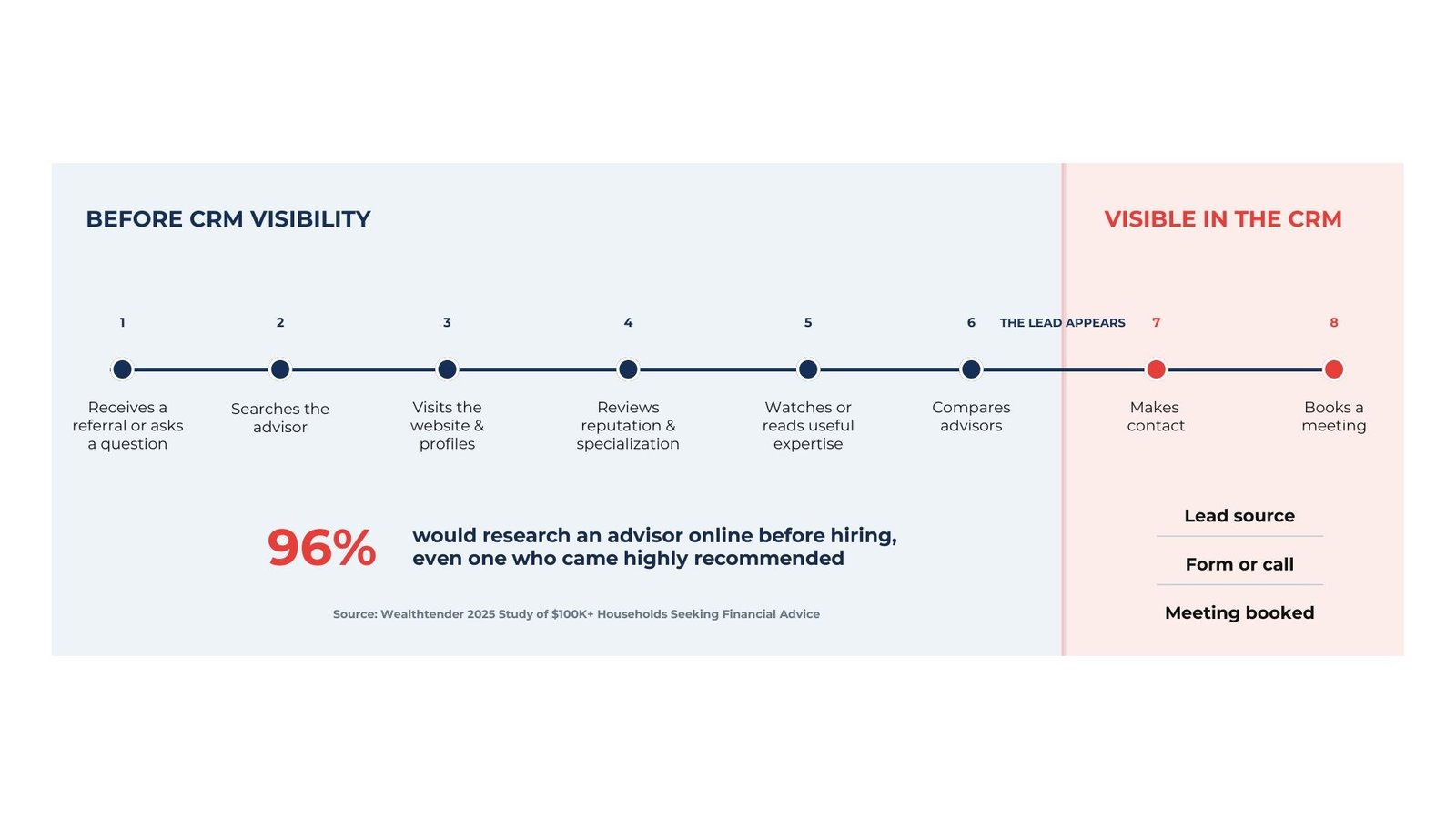
Referred prospects still research a financial advisor online before they hire. They search the advisor’s name, visit the firm’s website, check specializations and reputation, and watch or read content that shows how the advisor thinks. The advisor’s digital presence has to confirm what the referral promised.
Survey data now puts a number on it. In Wealthtender’s 2025 survey of 500 U.S. households earning $100K or more, 96% said they would research an advisor online before hiring, even one who came highly recommended, and 97% plan to interview more than one advisor.
The referral creates attention
Most people do not research an advisor because they distrust the person who made the referral. They research because the decision carries weight. Financial advice involves personal information, long-term consequences and a relationship that may continue for years.
The prospect wants to answer practical questions before scheduling a meeting. Does this advisor work with people like me? Do they understand the situation I am facing? Can I understand their approach? Do they communicate in a way that feels clear and credible?
A referral may establish initial credibility. The advisor’s digital presence must provide enough evidence to support the next step.
Referral and organic discovery now share the same middle
A prospect can enter the journey in two ways. One receives an advisor’s name from a friend, accountant or attorney. Another begins with a question about retirement, selling a business, inheriting money or managing a sudden change in wealth.
Referred prospects and organic searchers quickly converge on the same path. Both prospects search, assess fit and look for useful evidence of expertise. Both may compare several advisors. Both want to reduce uncertainty before sharing personal information or booking a meeting.
For financial advisors, referral marketing and content marketing should no longer operate as separate ideas. Content helps a referred prospect validate the recommendation. It also gives an unknown prospect a reason to discover the advisor in the first place.
Useful content provides evidence of fit
A polished website can confirm that the firm exists. It may communicate credentials, services and professional standards. Those elements matter but they rarely show a prospect what it might feel like to work with the advisor.
Original thought leadership can close that gap. A useful article can answer a specific question. A video can reveal the advisor’s communication style. A longer conversation can show how the advisor approaches uncertainty, explains trade-offs and helps clients make decisions.
The goal is not to publish as much as possible. The goal is to create enough relevant evidence for the right prospect to understand the advisor and decide whether the relationship may fit.
The CRM captures the end of a longer journey
Most customer relationship management systems begin tracking a prospect when someone completes a form, books a meeting or enters the pipeline. By then, the prospect may already have encountered several pieces of content and formed an initial opinion.
Because the CRM only sees the end of the journey, advisory firms face a measurement gap. A lead may be attributed to a referral even when the advisor’s website, videos, articles or reviews gave the prospect enough confidence to act. An organic lead may appear to come from a single search even though months of consistent expertise created familiarity.
Advisory firms can improve the picture by asking new prospects what they reviewed before making contact, recording content influence separately from lead source and tracking which topics support qualified conversations.
What should a prospect find when researching an advisor?
An advisor does not need to dominate every channel. The digital presence should provide a clear and consistent answer to several questions:
- Who does the advisor help and which situations do they understand particularly well?
- What questions or decisions can the advisor help a client work through?
- Can the prospect see or hear how the advisor communicates?
- Do the website, professional profiles and published content reinforce the same expertise?
- Does the prospect have a clear and appropriate next step?
If the answers remain difficult to find, the referral has to carry the entire burden of trust. If the answers are clear, content strengthens the referral and makes the advisor easier to choose.
Frequently asked questions
Do people research financial advisors online before hiring?
Yes. In Wealthtender’s 2025 survey of 500 U.S. households earning $100K or more, 96% said they would research an advisor online before hiring, even one who came highly recommended. They look for specialization, reputation and content that shows how the advisor thinks.
Do referrals still matter for financial advisors?
Yes. Referrals remain a valuable source of attention and transferred trust. Online research now works alongside the referral by helping the prospect validate the recommendation and assess fit before making contact.
Does every advisor need a podcast?
No. Advisors need a repeatable way to capture original expertise and turn it into useful content. Depending on the audience and business objective, that source may be a podcast, video series, webinar, roundtable or another structured conversation.
How can an advisor tell whether content influences leads?
Start by asking prospects what they watched, read or searched before booking. Track original lead source and content influence as separate fields. Over time, this creates a more accurate picture of which topics and formats contribute to qualified conversations.
The next question for advisors
Prospects are already researching advisors before making contact. The practical question is whether what they find helps them understand the advisor, assess fit and move forward with confidence.
ProudMouth helps financial professionals turn human expertise into connected content that supports discovery, referral validation and qualified conversations.